Cooking Simply and Well — What I’ve Learned After Years of Average Meals
There was a cooking class in my first year of high school that I’ve never quite forgotten and has set me on my path of cooking simply at home.
It was mandatory for a term — the kind of subject nobody asked for and most people treated as a free period with an oven. But somewhere between the measuring and the stirring, something clicked for me. I remember one of our most ambitious tasks was making a crème caramel. Eggs, milk, cream and sugar. Four ordinary things that, with a bit of heat and patience, became something else entirely. I was blown away. It tasted amazing. It was something you could be genuinely proud of putting in front of others, and it took just once class to do.
It got me thinking: do I want to do this for a living?
Well, I do not do this for a living. Chefs work too long, too late, and are badly underpaid. But the fascination — the idea that cooking is fundamentally an act of transformation — never really left. And I learned a lesson through this, just because you like something, you don’t need to make it your job. In fact, some things that light you up doesn’t mean you need to make it your job.
The share house years
My first share house had six people living in it, plus a rotating cast of partners and friends that the party house it was attracts. We weren’t quite as cramped as you may think. It was large enough to fit everyone, but also chaotic enough that any attempt at order was mostly theoretical.
We had romantic notions, as young people often do. We’d share meals. We’d take turns. It would be communal and civilised and vaguely European.
What it actually was: industrial quantities of spaghetti bolognese, cooked multiple times a week, with sauce from the largest jars the supermarket stocked. The communal cooking agreement lasted until people stopped pulling their weight, or until someone wanted something — anything — other than bolognese. Both happened around the same time.
Some damage runs deep. I still rarely cook bolognese.
One of my contributions to the rotation was a creamy tuna bake. Pasta again, because you’re feeding an army on a student budget, and tinned tuna because of how it somehow stretches in a dish like this. It was fine. It did the job. It was not a dish I felt particularly proud of, but pride wasn’t really the point. Being fed was the point.
What extended out from those years, in a cooking sense, was a television programme called Ready Steady Cook.
If you’re not familiar with it: contestants would arrive with a bag of seemingly random ingredients and the challenge was, with a rotating line up of chefs, to turn them into a range of meals worth eating. All up against a time limit of 30mins. I used to watch it in awe. Not just by the food, but by the creativity of it. The way a good cook could look at an apparently incompatible collection of ingredients and see a dish where I saw confusion. It was captivating.
It planted an idea that’s stayed with me since: cooking is really only limited by your creativity. And creativity, it turns out, you can practise. The show sent me hunting for bolder dishes, and I soon stumbled across the magic of pastry. Which led, eventually, to baking savoury pies — something I’ve been making ever since. Saved these days for occasions that feel worth the effort.
I started with pies by simply having a go, guided mostly by free cooking magazines I’d pick up wherever they appeared, and the gusto, and perhaps naivety of a contestant on Ready Steady Cook. I’ve used frozen pastry the whole time and I’m not remotely embarrassed about it. I’ve read enough that the frozen stuff is, within reason, just as good and I believe it — the pie doesn’t know the difference. The filling is where you can put the work in: savoury mince, thick beef in dark gravy, chicken and vegetables, the occasional wildcard (fish mornay, curry — really a lot can go in a pie, not unlike a toasted sandwich, though with considerably more ambition). People tend to love them. That’s enough for me.
My brother
My oldest brother is an unassuming cook. He was fairly rebellious growing up and stayed rough around the edges as a young adult. Being my older brother, I looked up to him and spent a lot of my formative years in his sphere. His place was the first house I went to and had too much to drink, where I partied as a teenager with my friends and felt cool hanging around people a few years older. Yet through all of that looseness, he somehow became a really great cook early on. Not a fancy cook. A great cook. And he managed to get there in his very early 20s.
I remember one of the many times I was at his place with a group of friends, he served a risotto that genuinely stopped me in my tracks. Up until this point I’d written off risotto entirely as something bland, boring, often cooked to the point of glugginess and resulting in an underwhelming meal, leaving you full but unsatisfied. He managed to avoid all of this. Simple touches like pancetta cooked in the oven until crispy, adding it at the last minute to keep the texture. Roast pumpkin, sweet and slightly caramelised was mixed through the rice. Rice that was cooked right, without the glug. A dish that on paper sounds straightforward and on the plate was one of those meals where everyone goes back for seconds without quite knowing why.
I still don’t really cook risotto — I’ll leave that one to him — but that meal taught me something I’ve held onto since. You don’t need a fancy kitchen. You don’t need expensive ingredients or elaborate technique. You need a basic pantry, a considered approach, and a genuine desire to feed people well. If you’re willing to lean in and try, the rest should follow over time.
He’d sometimes come around to my share houses and raise the occasion. One afternoon we cooked a whole Red Emperor on the BBQ — ambitious, slightly chaotic, the kind of thing you attempt when you’re young and haven’t yet learned to be cautious. To this day that fish is one of the best I’ve ever eaten. It probably wasn’t, objectively. But the situation, the friends, the fact that we’d just had a crack at something none of us really knew how to do yet it paid off — it left a mark. Food is never just the food.
What my brother had — and what I’m still honestly working on — is a natural vision for flavours that work well together. Not a prodigy thing. Rather accumulated knowledge, applied with confidence. The kind of thing that looks effortless from the outside and is actually the product of years of cooking and paying attention.
The long game
The other person who shaped my appreciation for cooking is my mother. I’m aware this risks sounding like a cliché, so I’ll try to be specific.
Growing up, I remember watching her cook every afternoon and the aromas that came with it. What struck me, even then, was the variety. We were a typical boring middle Australian household — there was plenty of meat and three veg — but there was also a wok out regularly for stir-fries, there were curries, Middle Eastern dishes, ingredients I didn’t recognise and wasn’t always sure about. She seemed to genuinely enjoy the process and take it upon herself to keep trying new things. As an adult, I can now imagine how tiring that must have been after a full day. I didn’t appreciate it at the time. I do now.
They always had a vegetable garden growing up — sweet potatoes, carrots, tomatoes, pumpkins, pawpaw, always changing with the season. There were fresh eggs from chickens in our yard. My grandfather on Dad’s side was an award-winning organic grower in his suburban garden, which I completely failed to comprehend as a kid. He was probably a trailblazer for his era. I grew up around good produce and didn’t know it.
What I thought was good cooking then, has grown over time into exceptional. It’s not uncommon to arrive at my parents’ place for lunch and find snacks, an entree, a main with several sides and salads and something for dessert. My mum is a coeliac and you would genuinely never know — we never feel like we’re doing without anything. Even a quick weeknight meal has an undeniable depth of flavour. She buys good ingredients, yet not always expensive ones, and I’ve come to understand that this is one of the most foundational things in cooking. In season produce. Simple things, handled well.
The dish I’ve requested for my birthday for as long as I can remember is her lasagne. I’m fairly certain it’s not the classic original. It’s original to her and to me, and she makes it just right. My wife has gone out of her way to learn it, and I love her for that — it’s just as good, but different in a way I don’t think I’ll ever quite be able to narrow down. Some things are like that.
My wife should get her own part here. She’s become such an amazing cook since we’ve known each other and I envy her repertoire of genuine go-to dishes. A list I plan to build of my own.
What I’ve actually learned about cooking simply at home
A few things that have genuinely made a difference — not instructions, just observations from years of getting it wrong first.
Read the ingredient list, not the price. The Thai curry paste I buy regularly is the cheapest one at the supermarket. It also has the most recognisable ingredient list and tastes the best. Just pure herbs and spices. The more expensive versions often have longer lists full of things I can’t identify. Cheaper, tastier, better for you — this happens more often than the packaging suggests. Pre-shredded cheese has caking agents in it and costs more than a block. Taco seasoning is cheaper and better when you make it yourself from spices you already have. The best tomato sauce usually isn’t the most expensive one. Cheaper cuts of meat — chuck steak, osso bucco — slow cooked properly are often more satisfying than expensive ones cooked quickly.
Grow herbs if you can. Fresh herbs are meaningfully better than dried in most applications. More importantly, having them just outside means you actually use them — and using fresh herbs well is one of the fastest ways to make ordinary food taste considerably better. We’ve grown basil, rosemary, thyme, flat-leaf parsley and chives. They don’t always last long term like basil, but it’s always a treat while it lasts.
The things I haven’t cracked. Many things. Noodles as an example, genuinely. They end up gluggy every time. I’m blaming the lack of a gas stove and a proper wok and I’m mostly at peace with that.
Sunday afternoon
These days the cooking I love most happens on Sunday afternoon.
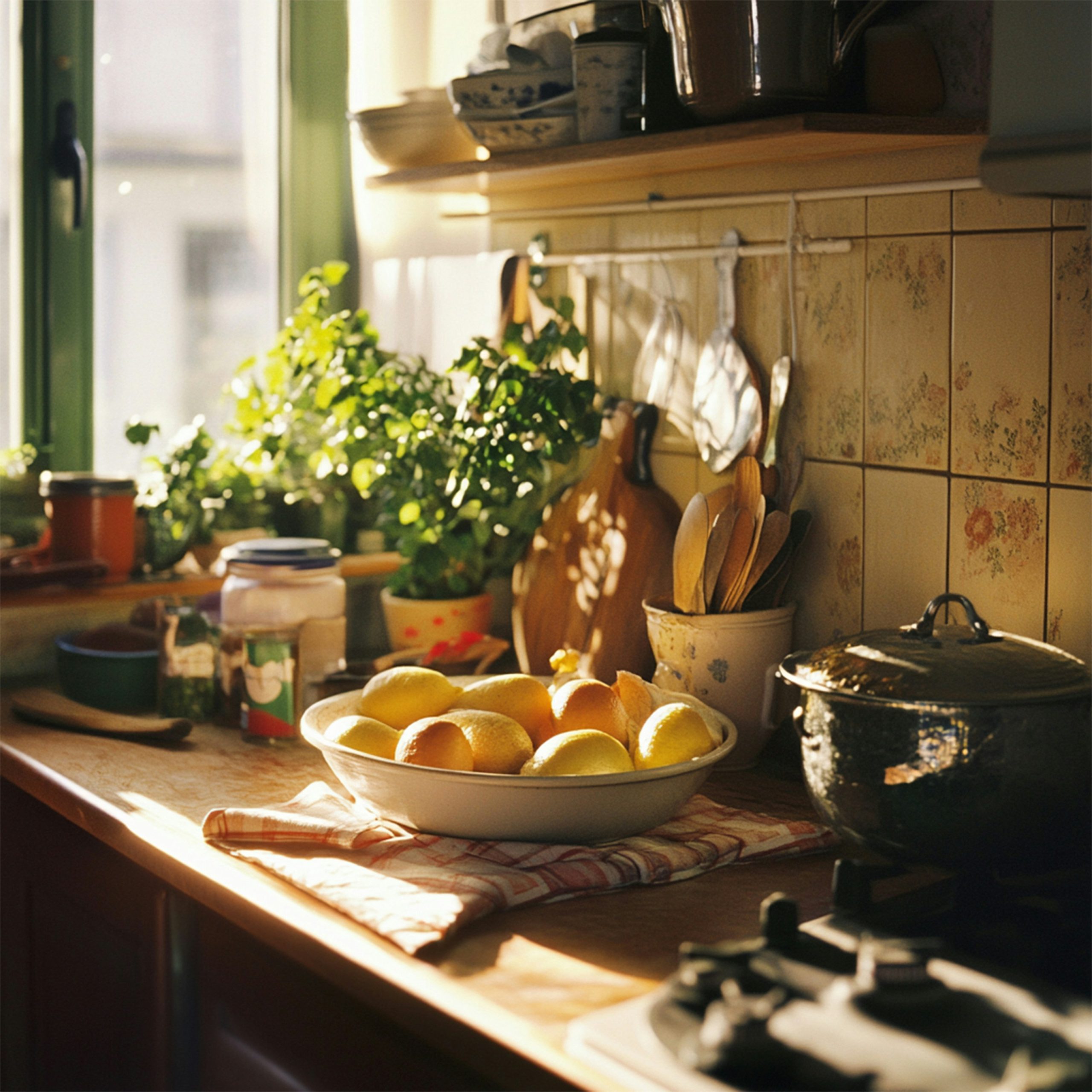
It starts around three or four — later if life has had other plans, earlier if the dish calls for it. Slow cooked things mostly: things like a beef stew, something with chuck steak or osso bucco that’ll go for hours and reward the patience. Or a roast chicken which I recommend as one of the most fail-safe dishes around. The house fills with aromas well before the meal is ready. The meal almost starts hours earlier, developing and growing on the stove while the afternoon does the same thing around it.
It’s become something of an anchor in the week. A signpost. If I don’t get it, something feels off as Monday arrives — which is probably something I should examine, but not today. Today there’s a pot on.
These days there’s usually a small person who wants to be carried over to the bench to watch proceedings with vivid interest. My daughter, six months old and apparently fascinated by the whole process. I’m not going to pretend that doesn’t make it better. It does.
Sometimes there’s a wine or a beer. Always the smells. Always the unhurried feeling that comes from cooking something that doesn’t ask you to rush.
That’s what I was trying to find in that high school kitchen, I think. The transformation. The unhurried process. The thing at the end that you made yourself, and that means something because of it.
I’m still learning. Slowly.
— Dave
Want to follow along?
One email every week or two on living better. No noise, no fluff.