How to Declutter Without It Becoming a Personality
There’s an anvil in my nana’s old shed that isn’t going anywhere.
It’s too heavy to move, and by the sound of it, always has been. It was there since she and pop moved in (my pop was a metal worker in his earlier years), and it’ll probably be there after whoever buys the house next moves on too. I imagine it outliving all of us — still sitting in that shed long after the house has changed hands a few more times, maybe even after the house itself is gone and nature has reclaimed the block. Not an heirloom. Not sentimental. Just a “comes with the house” object because it’s too heavy to move.
Nana passed last year. I remember a decade ago, when she and pop were downsizing, the extended family spent a weekend going through a house that had quietly filled up over about fifty years. A garage sale followed to try and get rid of piles of things that hadn’t been touched in a long time. Then, when she passed, we did it all again — just her side this time, pop had gone a few years earlier — and one enormous shed that nobody had properly gone through in nearly a decade. It sucked.
She wasn’t careless, and she definitely wasn’t malicious about it. She was, by most reasonable definitions, a hoarder — not television-extreme, just the kind of quiet accumulation that happens over fifty years when almost nothing ever leaves. And what she left behind wasn’t really hers to deal with in the end. It was someone else’s.
That’s the part that’s stayed with me. Not the stuff — most of it wasn’t valuable, sentimentally or otherwise. It’s that the job of deciding what mattered and then what to do with it, got handed to others, and sometimes at exactly the point they were least equipped for it. My mom, being the oldest in the family, had to organize a lot of it and through her I saw the toll it can take.
There’s a Swedish concept that I’ve since heard about. Döstädning, or death cleaning: the practice of clearing out your own belongings, gradually, before someone else has to do it for you, at the worst possible time, without any of your context. Less morbid than it sounds. It’s really just a decision to make the job yours instead of leaving it as someone else’s. An act of love, when you frame it that way, rather than an act of tidying.
I’m nowhere near ninety-one years old. Death cleaning in the strict sense isn’t exactly urgent for me. But it helped give extra texture to something I’d been half-thinking about anyway: decluttering isn’t just about the person doing it. In its most extreme sense it can be about who inherits the decision if you don’t. Putting things off just make the problem worse, and it becomes too large to mentally tackle. Don’t make it someone else’s burden.
The version I find exhausting
There’s a genre of how to declutter content I find slightly exhausting. The dramatic before-and-afters. The capsule wardrobes reduced to an exact number of items. The philosophy that turns clearing out a kitchen drawer into a statement about the human condition.
I understand the appeal — transformation makes for compelling content, and there is something genuinely moving about stripping back to what actually matters. But for most of us that’s not the entry point. It’s not where you start. And the gap between where you actually are and where that content lives can make the whole thing feel impossible before you’ve decide to part ways with a single thing.
Here’s a more honest version of how to declutter, at least the way it’s actually worked for me.
How stuff accumulates without anyone deciding it should
Nobody decides to let things pile up. It happens the way most drift happens — gradually, invisibly, one reasonable decision (and sometimes less reasonable decisions!) at a time.
You keep something because it might be useful one day. You hold onto it because it was a gift, and getting rid of a gift feels a bit ungrateful. You don’t throw it out because it still technically works, even though you haven’t touched it in four years. You put it in a drawer, and the drawer’s already full of things you also haven’t used in years, and somehow that makes it feel organised rather than the opposite. It still fits, and it looks ok, but you never tend to put it on.
Living in our first place — a tiny terraced townhouse — actually helped me here more out of necessity than anything. Small spaces don’t really allow for quiet accumulation. There’s nowhere for it to hide. You either deal with things or you trip over them, so we got reasonably good at only keeping what earned its place and revisiting what we truly wanted or needed. It also allowed us to at times spend less, but on more high-quality items that we really liked.
Most of us get to a point where a proper clear-out is overdue. The question is how to do it without turning it into a production you’ll put off indefinitely — which, if I’m honest, is most of us most of the time.
Decluttering tips that actually work for me
I’ve read a bit on this — Marie Kondo’s is the obvious one, and it’s genuinely useful, though the full method asks for more time and energy in one hit than most people have going spare. What I’ve actually taken from it and use in practice is a lot simpler.
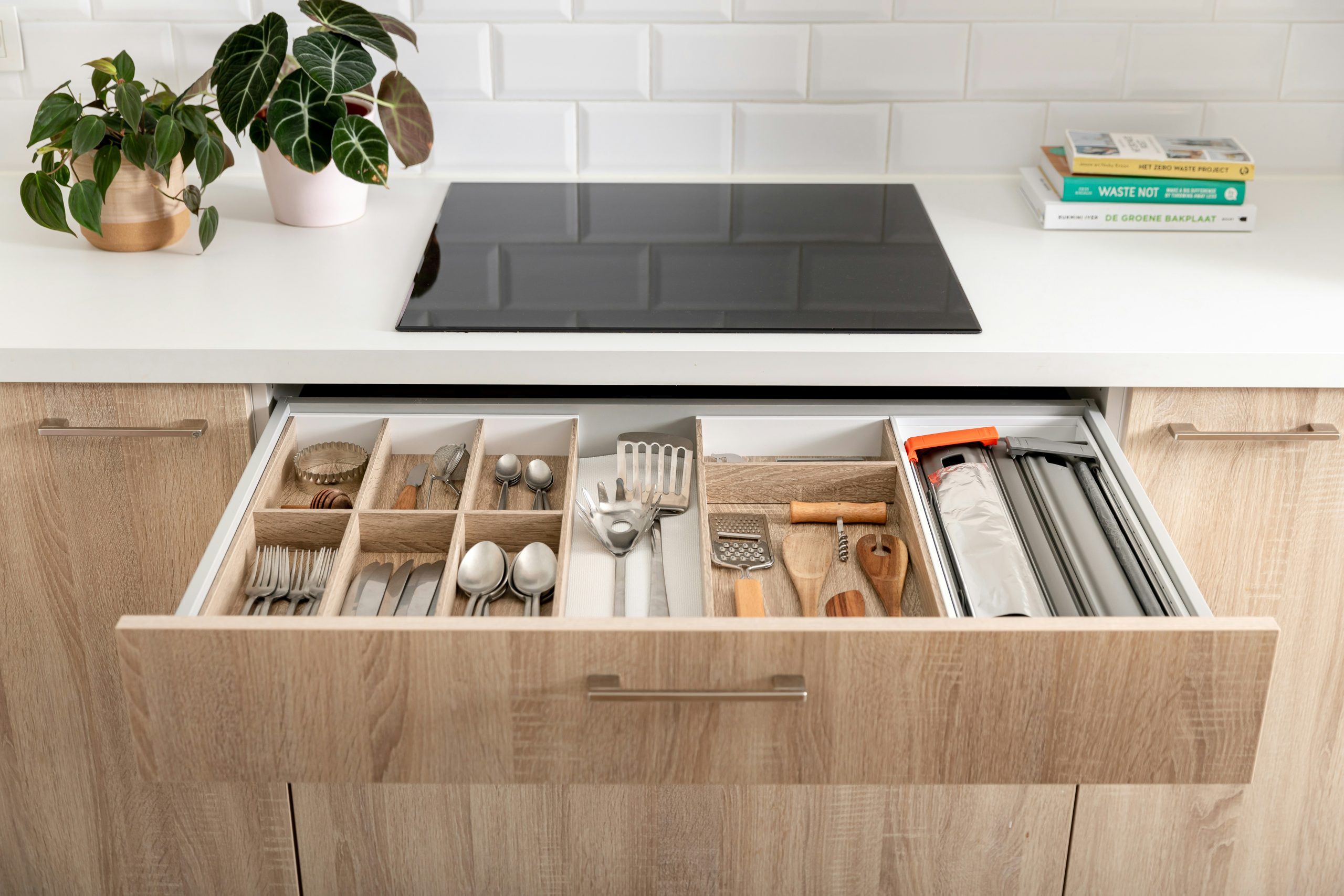
Start with something small. One drawer. Not the garage. Not the whole wardrobe. One drawer.
Take everything out. Go through it properly. For each thing, ask honestly: do I use this, do I love this, is there a real reason to keep it? If the answer’s no on all three, it goes.
Rehome things thoughtfully where you can. Anything in decent condition can go to a charity shop, or onto eBay or Facebook Marketplace. Knowing something you no longer need might actually find its way to someone who’ll use it — and might even put a few dollars back in your pocket along the way — makes the whole exercise feel a lot better than just binning it. For some the reward of receiving some funds to put towards something else can be a real motivator.
Then stop. You’ve done one drawer. That’s enough for today.
The share house reckoning
If the townhouse taught me small spaces force honesty, share houses taught me the opposite lesson from the other direction.
I lived in something like eight share houses through my twenties. And the one guarantee of share house life is that eventually everyone moves out — and moving out means physically confronting every single thing you’ve accumulated, in boxes, on a weekend, usually hungover, usually in summer.
It’s a genuinely horrendous process. You find things you forgot you owned. You find things you’re mildly embarrassed to have owned. Then there are things like the communal table that someone grabbed second hand for the house because they thought it would be useful, and then no one really owns it or takes responsibility for it. At one point someone thought it would be a good idea to bring a musical organ home. I mean an organ…really? Do you know how heavy those things are? I don’t think I saw a single person play it ever — or the oversized blue armchair someone grabbed for the corner of the living room, which sat there for two years because nobody wanted to be the one to admit it needed to go.
What is prone to happening here is that stuff moved house with you purely because packing it was easier than deciding what to do with it. Moving is hard enough as it is. Don’t make it harder than it needs to be by dragging four years of undecided stuff along with you every single time.
The wardrobe specifically
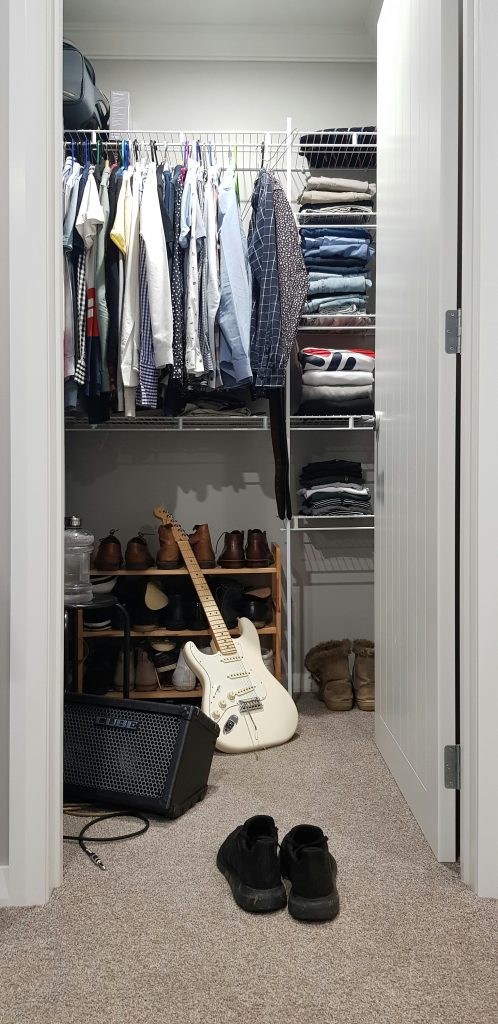
The clothes you’re left with after a proper clear-out tend to have something in common. Might be the fit, a particular look, the quality of the material — or just that they’re things you actually reach for.
A cleared-out wardrobe is a decent diagnostic, honestly. What survives tells you something about what you actually like, as opposed to what you thought you’d like when you bought it, or thought you should own, or bought simply because it was cheap enough not to think about.
If you’re rebuilding from there, the circular economy is genuinely excellent — eBay, Depop, Facebook Marketplace. Good pieces in good condition for a fraction of the original price. You’re extending the life of something that already exists instead of creating demand for something new. The maths and the ethics point the same direction for once.
What I haven’t figured out yet
Here’s where I’ll be honest and admit I don’t have this fully sorted.
We’ve got a six-month-old, and the volume of stuff that comes with a small person is something nobody properly warns you about. Clothes she’s grown out of in six weeks. Toys from well-meaning relatives and friends. I think we have around fifteen stuffed animals now, and she’s not remotely old enough to have an opinion about any of them. She might have played with two.
Some of it’s genuinely useful. Some of it’s sentimental — a gift from someone who mattered, or the first thing she ever properly held. And some of it is just… inbound. Arriving faster than we can make decisions about it, sitting in piles we keep meaning to sort but mostly don’t. My wife has been amazing about taking some of the lead on this, but the volume is still overwhelming and realistically, most of it might need to stay for a few years.
I don’t have a tidy answer for this bit yet. I suspect the honest one is that sentimental and functional need different rules, and I haven’t worked out what those rules are. Working on it. Slowly.
Decluttering is ongoing
These days if I’m talking to a friend about how to declutter, my main learning is that it isn’t really a project you finish. It’s a habit, or it should be.
The most useful shift for me has been treating it as ongoing curation rather than a one-off intervention. Things come in, things should go out, and paying periodic attention to that movement — rather than letting it build until it reaches crisis levels, or in extreme cases, until it becomes someone else’s job — is a lighter and far more sustainable way to live with your own stuff.
It touches on something I’m more attracted to these days – curating a more simplified life, less but more high-quality items, and more thoughtful purchasing.
It changes what you bring in, once you’ve felt the other side of it. After an afternoon clearing out things you once paid good money for and never used, you start asking a different question before you buy something new: will I actually use this, or will I just move it from place to place for a few years and then quietly get rid of it?
That question, asked honestly and often enough, saves a lot of future decluttering.
That anvil is an extreme example, but it’s a decent test for how to declutter anything — decide whether to keep it while you’ve still got the context to make that call properly. Not because everything needs that level of scrutiny — it doesn’t, that way lies its own kind of madness — but because it’s a useful reminder that the things we keep eventually become someone else’s decision, one way or another. Might as well make a few of those calls myself, while I’ve still got the context to make them properly.
— Dave
Want to follow along?
One email every week or two on living better. No noise, no fluff.